

Introduction
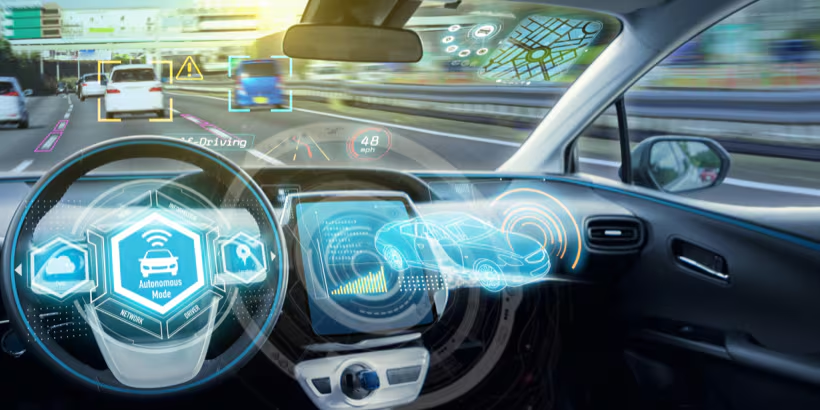
Autonomous vehicles (AVs) are transforming transportation by enabling self-driving cars, trucks, and delivery robots to operate with minimal human intervention. A critical enabler of this technology is Edge AI, which brings artificial intelligence (AI) computation closer to the vehicle itself rather than relying solely on cloud processing.
Edge AI allows autonomous vehicles to make real-time decisions, process massive amounts of sensor data locally, and improve safety and efficiency on the road. Understanding the applications of Edge AI in autonomous vehicles highlights how this technology is redefining mobility and intelligent transportation.
What Is Edge AI in Autonomous Vehicles?
Edge AI refers to the deployment of AI algorithms on devices at the “edge” of a network, such as sensors, cameras, or onboard processors in vehicles. Unlike traditional cloud-based AI, Edge AI processes data locally, reducing latency and bandwidth usage.
In autonomous vehicles, Edge AI powers tasks such as:
- Object detection and classification (pedestrians, vehicles, traffic signs)
- Lane detection and navigation
- Predictive maintenance and vehicle diagnostics
- Driver behavior monitoring
- Real-time decision-making for collision avoidance
By performing AI computations on the vehicle itself, Edge AI ensures immediate responses critical for safety and autonomous operation.
Key Applications of Edge AI in Autonomous Vehicles
1. Real-Time Object Detection
Autonomous vehicles rely on cameras, LiDAR, radar, and ultrasonic sensors to perceive their surroundings. Edge AI processes this sensor data instantly to detect obstacles, traffic signals, pedestrians, and other vehicles. Quick recognition allows the vehicle to react within milliseconds, preventing accidents.
2. Advanced Driver Assistance Systems (ADAS)
Edge AI enables features such as adaptive cruise control, lane departure warnings, and automated emergency braking. By processing data locally, the system minimizes latency and improves responsiveness, making driving safer for both passengers and pedestrians.
3. Predictive Maintenance
Edge AI monitors vehicle components like engines, brakes, and batteries in real-time. Predictive analytics help identify potential failures before they occur, reducing downtime and maintenance costs while enhancing safety and reliability.
4. Autonomous Navigation
Edge AI combines sensor data with preloaded maps and routing algorithms to plan optimal paths. This allows vehicles to navigate complex environments, such as urban streets or highways, without relying entirely on cloud connectivity.
5. Driver and Passenger Monitoring
Edge AI systems track driver attentiveness, detect drowsiness, and monitor passenger behavior. Real-time analysis ensures safety by alerting the driver or taking corrective action when necessary.
6. Traffic Flow Optimization
Vehicles equipped with Edge AI can communicate with other vehicles (V2V) and infrastructure (V2I) to optimize traffic flow, reduce congestion, and improve fuel efficiency. Local AI processing reduces dependency on central servers, enabling faster decision-making.
Table: Edge AI Applications in Autonomous Vehicles
| Application | Edge AI Role | Benefits | Challenges |
|---|---|---|---|
| Real-Time Object Detection | Processes sensor data locally | Immediate obstacle recognition, accident prevention | High computational requirements |
| Advanced Driver Assistance Systems | Provides low-latency safety features | Improved safety and responsiveness | Complex algorithm integration |
| Predictive Maintenance | Monitors vehicle health in real-time | Reduced downtime, cost savings | Accurate data collection needed |
| Autonomous Navigation | Combines local sensor data with maps | Efficient route planning, cloud independence | Sensor fusion complexity |
| Driver & Passenger Monitoring | Analyzes attention and behavior | Enhanced safety | Privacy concerns |
| Traffic Flow Optimization | Enables V2V & V2I communication | Reduced congestion, improved fuel efficiency | Network interoperability |
Advantages of Edge AI in Autonomous Vehicles
- Reduced Latency
Processing data locally ensures instant responses for critical tasks like braking and obstacle avoidance. - Bandwidth Efficiency
Edge AI minimizes the need to send large volumes of sensor data to the cloud, reducing network load. - Enhanced Reliability
Vehicles can operate even in areas with poor network connectivity since critical AI computations are performed onboard. - Improved Privacy
Sensitive data such as in-cabin video footage is processed locally, minimizing exposure to cloud servers. - Scalable Vehicle Operations
Edge AI allows autonomous vehicle fleets to scale efficiently without overwhelming central servers with data.
Challenges in Implementing Edge AI
Despite its advantages, deploying Edge AI in autonomous vehicles presents several challenges:
- Hardware Constraints: Onboard AI processors must balance computational power with energy efficiency.
- Real-Time Processing: Ensuring algorithms respond within milliseconds requires optimized AI models.
- Data Fusion Complexity: Combining data from multiple sensors (LiDAR, cameras, radar) accurately is challenging.
- Cybersecurity Risks: Edge AI nodes must be secured against hacking attempts. Modern applications rely on principles similar to Importance of API Security in Modern Applications to ensure secure communication and data integrity.
- Cost and Scalability: High-performance Edge AI chips increase vehicle production costs.
Best Practices for Edge AI Implementation
- Use Optimized AI Models
Lightweight neural networks or model compression techniques reduce processing load while maintaining accuracy. - Integrate Redundant Sensors
Combining multiple sensors improves reliability and reduces the likelihood of misdetections. - Regular Software Updates
Edge AI systems require frequent updates to adapt to evolving traffic patterns and safety standards. - Implement Cybersecurity Measures
Encrypt communication between edge devices, monitor anomalies, and follow secure coding practices. - Collaborate with Cloud Systems
While Edge AI handles real-time processing, the cloud can be used for training models, long-term analytics, and fleet-wide updates.
Frequently Asked Questions (FAQs)
What is the difference between Edge AI and cloud AI in autonomous vehicles?
Edge AI performs computations locally on the vehicle, reducing latency and dependence on network connectivity, while cloud AI processes data remotely, often for training models or large-scale analytics.
How does Edge AI improve safety in autonomous vehicles?
By processing sensor data in real-time, Edge AI enables immediate decision-making for obstacle avoidance, lane-keeping, and emergency braking.
Are all autonomous vehicles using Edge AI?
Most modern autonomous vehicle prototypes and commercial models integrate some form of Edge AI to ensure safety and responsiveness, especially for critical driving functions.
Can Edge AI work without a network connection?
Yes, one of the advantages of Edge AI is that it allows vehicles to operate independently of cloud connectivity for real-time tasks.
How does Edge AI relate to cybersecurity in AVs?
Edge AI devices must be secured to prevent tampering or hacking, following best practices similar to those in Importance of API Security in Modern Applications to maintain safe and reliable vehicle operations.
Conclusion
Edge AI is revolutionizing autonomous vehicles by enabling real-time decision-making, improving safety, and reducing reliance on cloud infrastructure. Its applications range from object detection and ADAS to predictive maintenance and traffic optimization.
While challenges like hardware limitations, sensor fusion complexity, and cybersecurity risks exist, best practices in AI model optimization, sensor integration, and secure communication make Edge AI a cornerstone of autonomous vehicle technology.
As the industry advances, Edge AI will continue to drive innovation in autonomous mobility, creating safer, more efficient, and intelligent transportation systems worldwide.


