

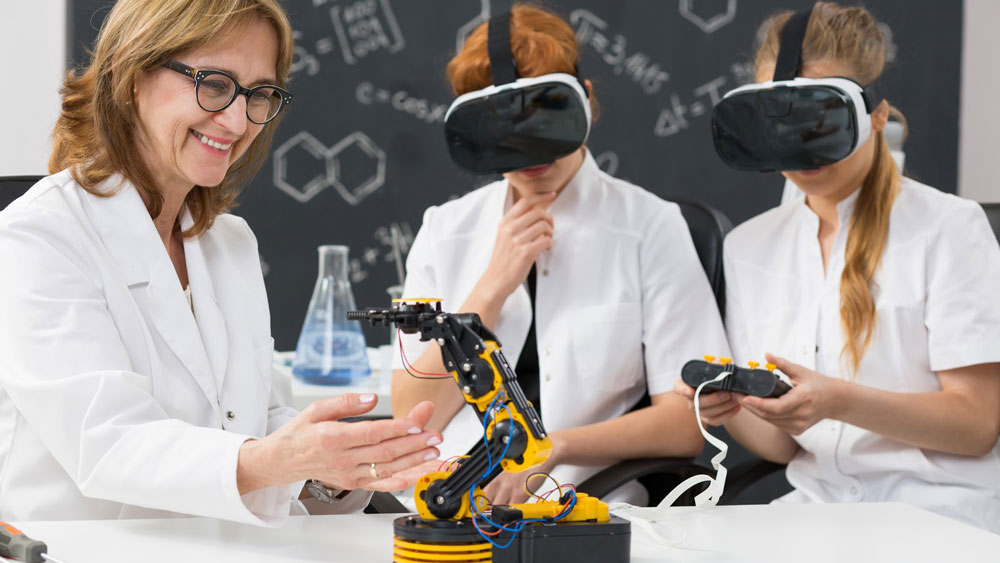
Virtual reality (VR) is rapidly reshaping the education sector by creating immersive, interactive, and engaging learning experiences. Unlike traditional teaching methods, virtual reality allows students to explore environments, interact with concepts, and practice skills in ways that were previously impossible. From elementary classrooms to higher education and professional training, VR applications in education are redefining how knowledge is delivered and understood.
What Is Virtual Reality in Education?
Virtual reality in education refers to the use of computer-generated environments that simulate real or imaginary worlds. Through VR headsets and compatible devices, learners can experience three-dimensional spaces where they can move, observe, and interact with educational content.
These environments enhance experiential learning by placing students at the center of the lesson rather than making them passive recipients of information.
Why Virtual Reality Is Important for Learning
Virtual reality addresses several limitations of traditional education. It improves engagement, supports different learning styles, and enables practical learning without real-world risks or costs.
Key benefits include:
- Increased student motivation and focus
- Enhanced understanding of complex concepts
- Safe simulation of real-life scenarios
- Equal access to experiences regardless of location
As digital learning continues to grow, VR is becoming an essential educational tool rather than a novelty.
Major Applications of Virtual Reality in Education
Virtual Classrooms
VR-powered virtual classrooms allow students and teachers to meet in simulated spaces. Learners can attend lectures, collaborate on projects, and interact with peers regardless of geographic barriers.
Science and Medical Training
VR enables students to explore human anatomy, conduct virtual experiments, and practice medical procedures without physical risk. Medical and nursing schools increasingly rely on VR simulations for skill development.
History and Geography Education
Students can visit ancient civilizations, historical landmarks, and distant countries through VR. This immersive approach improves retention and makes abstract concepts more tangible.
Technical and Vocational Training
Industries use VR for training mechanics, engineers, and technicians. Learners can practice assembling machinery or handling tools in a controlled environment before working on real equipment.
Special Education Support
Virtual reality offers customized learning experiences for students with special needs. Controlled sensory environments and personalized pacing help improve focus and comprehension.
Benefits of Virtual Reality for Students and Teachers
Virtual reality enhances both teaching and learning outcomes. For students, it creates memorable learning experiences. For teachers, it offers innovative tools to explain difficult topics and assess performance.
Some key advantages include:
- Hands-on learning without physical constraints
- Improved collaboration and communication
- Better assessment through interactive tasks
- Reduced training costs over time
Educational institutions adopting VR often report higher student satisfaction and engagement levels.
Challenges of Implementing Virtual Reality in Education
Despite its advantages, VR adoption in education faces challenges:
- High initial hardware costs
- Limited technical expertise among educators
- Need for curriculum integration
- Potential health concerns such as motion discomfort
However, as technology advances, costs are decreasing, and schools are increasingly using cost-effective solutions, including shared devices and entry-level systems that work alongside tools like Affordable Laptops with SSD Under $700.
Virtual Reality vs Traditional Learning Methods
| Aspect | Traditional Learning | Virtual Reality Learning |
|---|---|---|
| Student Engagement | Moderate | High |
| Learning Style Support | Limited | Multi-sensory |
| Practical Experience | Often theoretical | Experiential |
| Accessibility | Location-dependent | Location-independent |
| Cost Over Time | Repetitive material costs | Scalable after setup |
This comparison highlights why VR is gaining popularity as a complementary educational approach.
Future of Virtual Reality in Education
The future of VR in education looks promising. With advancements in artificial intelligence, cloud computing, and wearable technology, VR experiences will become more realistic and accessible. Schools and universities are expected to integrate VR into standard curricula rather than using it as an optional tool.
Remote learning, skill-based education, and lifelong learning programs are likely to benefit the most from VR innovations.
Best Practices for Using VR in Education
To maximize the effectiveness of VR, educators should:
- Align VR content with learning objectives
- Provide guided experiences rather than unstructured exploration
- Combine VR with traditional teaching methods
- Ensure accessibility for all students
- Train educators on VR tools and classroom integration
Balanced implementation ensures that VR enhances learning rather than distracting from it.
Frequently Asked Questions (FAQs)
Is virtual reality suitable for all age groups in education?
Yes, VR can be adapted for different age groups. Content and duration should be age-appropriate, especially for younger learners.
Does virtual reality replace teachers?
No, VR is a supportive tool. Teachers remain essential for guidance, explanation, and evaluation.
Is virtual reality expensive for schools?
Initial costs can be high, but long-term benefits and declining hardware prices make VR increasingly affordable.
Can VR be used for remote learning?
Yes, VR is highly effective for remote education, enabling interactive lessons and collaboration regardless of location.
What subjects benefit most from VR?
Science, medicine, engineering, history, and vocational training benefit significantly, but VR can enhance almost any subject.
Conclusion
Virtual reality applications in education are transforming the way students learn and teachers teach. By offering immersive, interactive, and experiential learning opportunities, VR bridges the gap between theory and practice. While challenges remain, continued technological progress and growing accessibility are paving the way for widespread adoption. As education evolves to meet the demands of a digital world, virtual reality stands as one of the most powerful tools shaping the future of learning.


